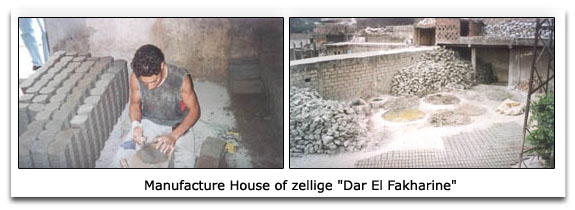
Fez clay, which enters in the composition of these tiles, is extracted in blocks and then submerged for daytime in a basin (the Zoubia). Legs and arms in the water, the mixer (Ajjan) kneads the clay to render it homogenous. Thereafter, the clay is pulled out and exposed to the sunlight in form of tiled blocks. Once consolidated, the clay is flattened on a board and perfectly smoothed out before divided into tiles of 10x10cm. Tiles are then dried in the sunlight. The first firing is done in a great kiln situated at the external side. The polished surface of the tile is then rapidly submerged into an enamel bath. The second firing is carried out at 800° to fix the enamel. Another day after the firing, the tiles are extracted and sorted out.
Concerning colours of the zellige, nature-coloured ancient enamels are used up to the beginning of the twentieth century. Since the Merinide Reign in Andalusia, colours have probably not evolved noticeably. This range of colours can be summarized into different varieties of brown, which may change from a quite-black colour into dark-yellow ochre, and into blue colour more or less shaded, or almond-green. Nowadays, this range has been remarkably enriched by vivid colours, which form beautiful combinations that break a heavy monotony.Artizelliges has gathered for you the almost complete range of colours with their shades, which exist in the Moroccan zellige.
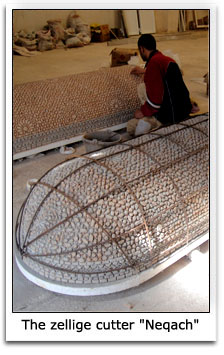
The zellige handcrafting is essentially of a great precision. The puzzle pieces are arranged in block following their colours and forms. The craftsman put them, one by one, on the reverse side upon a perfectly soft surface. He overlaps them to compose his board. He is in a squatting position or on his kneels, always concentrated. Thereafter, he casts cement onto the puzzle and let dry. Once the cement held, the panel is achieved (almost 100x60cm for an easy transportation, but some are very dimensioned) and will be used in the decoration of a wall, pillars or floors wearing zellige.
|